Improving care for parents who experience the loss of a baby must be a shared priority, the Royal College of Midwives (RCM) has told a baby loss conference in Northern Ireland.
Speaking at the Belfast event, organised jointly by the RCM and Sands to mark Baby Loss Awareness Week, the RCM’s Chief Executive Gill Walton stressed the importance of working together to make meaningful changes to bereavement care.
The conference Holding families through loss: A shared approach to bereavement care – brought together 120 delegates, including MLAs, midwives and student midwives, to share experiences, learn from one another and discuss how care and support for bereaved families can be improved.
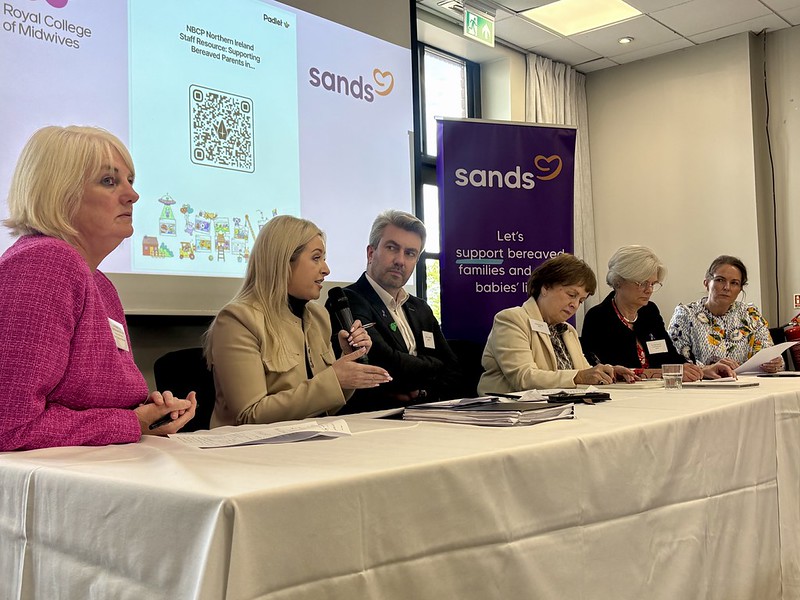
In a discussion called Bereavement care in 2027 panel: Policy, practice and political priorities, Gill said: “Maternity care and certainly bereavement care is one of the most important things to get right for women’s health. It’s about working together to make a change – if we’re in the same direction, then we can make that change together.”
Joining Gill on the panel were Diane Dodd MLA (DUP), Danny Donnelly MLA (Alliance), Orthlathi Flynn MLA (Sinn Fein) and Dr Clea Harmer, Chief Executive of Sands.
The panel discussed healthcare finances in Northern Ireland, with Gill adding: “There is a frustration that maternity services aren’t seen as a priority and that money is spent elsewhere – but if money is spent at the start of life and on getting it right, it could actually save money further down the line.”
The discussion comes ahead of the Department of Health’s Women’s Health Action Plan, which is expected to be published in the coming weeks.
Robbie Butler MLA, Northern Ireland’s Minister of Health, recorded a video message which was shown to the delegates, thanking the RCM and Sands for organising the conference, which was a “vital opportunity” for improving bereavement care in maternity in Northern Ireland.
He said: “Behind every statistic is a baby who is deeply loved and a family whose lives have been changed forever and it’s important that we never lose sight of that reality. I want to pay tribute to Sands, for the support it provides to bereaved families and for the tireless work in driving improvements in care. I’d also like to recognise the Royal College of Midwives and the wider maternity workforce. Parents’ memories of the care they receive at that moment will stay with them forever, and whilst we can’t turn back the clock, better care can help parents and families navigate their bereavement journey while poor care could add to the trauma of loss.
Opening the conference, Dr Harmer said: “Bereavement care needs to be everyone’s responsibility, not just one or two specialist midwives. Every healthcare professional needs bereavement care training.”
Also among the speakers at the conference was bereaved parent Kelly Barnes. Kelly spoke movingly about her experiences, including the difference that support from a specialist bereavement team made to her.
She has since gone on to volunteer for Sands and successfully campaign for baby loss certificates in Northern Ireland, paid leave for pregnancy losses before 24 weeks and child funeral funds.
Her message to the delegation was clear – bereavement care must be equitable and mental health support for parents needs to be improved dramatically.
Dr Dale Spence, Director of RCM Northern Ireland, said: “We were honoured to host this conference with Sands and it feels particularly poignant for it to be held at the start of Baby Loss Awareness Week.
“Losing a baby is devastating and the care and support families receive at such a difficult time can make an enormous difference.
“Today has shown just how important it is to make sure bereavement care is heard and prioritised at the highest levels of government. It has also reinforced the need for us to work together to ensure every parent and family across Northern Ireland receives the compassionate, high-quality bereavement care they need and deserve.”
“By bringing together bereaved parents, midwives, charities and decision-makers, we can learn from one another, challenge what needs to change and make a real difference.”