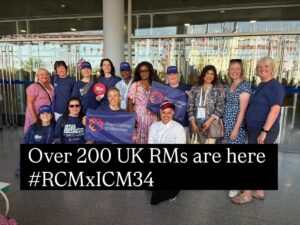
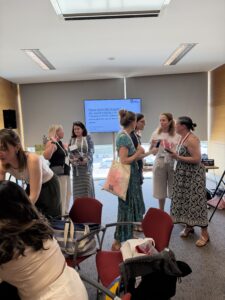
 It is a month since we all returned to our countries following the 34th ICM congress in Lisbon, 12 -18 of June 2026. More than 3000 midwives from all over the world gathered to discuss, develop and advance the midwifery profession. Of course, there was strong representation form the United Kingdom, with more than 200 midwives presenting, sharing research and practice innovations across England, Wales, Scotland and Northern Ireland. It was not only midwives that were present; paramedics, psychologists, medical anthropologists, activists and politicians were present to explore the sociopsychological aspects and impact of birth on women, birthing people, newborns and their families.
It is hard to isolate the learning from the 34th ICM Congress. It also seems unfair to mention only a few people, or projects, when across the six days from the march on the 12 June, to the closing Ceramony on the 18 June 2026, hundreds to thousands of midwives marched for One Million More Midwives. Gill Walton; the Chief Executive and Chief Midwife at the Royal College of Midwives (RCM), Vito Varela; president of APEO, and the outgoing ICM president, Sandra Oyarzo Torres united their voices to highlight that more midwives, clearly mean safe care. No woman will give birth alone and no family will face preventable tragedies again with one Million More Midwives. The number alone is not enough; systems change is needed globally. Infrastructure that supports the midwifery models of care, are well founded and supported systems need to be designed, developed and sustained globally.
Leadership can shape that path and as Sadra Oyarzo Torres states, “we don’t have to be ready to lead, we just need to follow the aspiration and work collaboratively”. The path will open before us once we pursue and support ethical provision on women centred midwifery care. We sang and danced together alongside the flag bearers of the countries attending; including our very own RCM President Sophie Russell. Paola Salwan Saher , an International Humanitarian and Human Rights Layer, reminded us that midwives are not just registered healthcare practitioners, but defenders of human rights, who are present in crisis, crafting the new generations and fighting for equitable access not only to care but to a fair and just society.
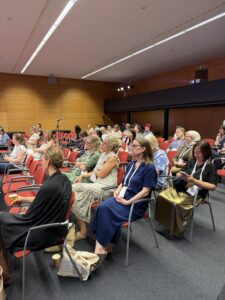 Each plenary session had a different focus, it is hard to capture everything discussed, but it is equally hard to forget Professor Soo Downe’s statement on the need for equitable access to services for all women and birthing people across the UK and internationally. It is not easy to dismiss the plea for development of pathways of care for women in prison and marginalised groups from Macarena Martinez. It is also difficult to ignore that midwives are lighthouses for women, families and societies and one another to navigate challenges and develop through adversity, as Jaki Lambert, RCM Scotland Country Director, stated “This brings to mind the unity and solidarity we lived and experienced throughout the conference. Unfamiliar humans, with diverse origins and unique individuality came together during the congress. The only common denominator was midwifery”. So, like a wave we all synchronised, learned, shared, interacted and made friends.
The sessions were many to recall, the posters were even more to have seen and read them all. Updates on latest clinical evidence, innovations in practice, workforce reviews, developments, education frameworks or methodologies, and latest research in maternity across the globe were presented. The discussions were not limited to what happened during the sessions. They expanded during all the breaks and in dinner tables all across the centre of Lisbon for the duration of the conference.
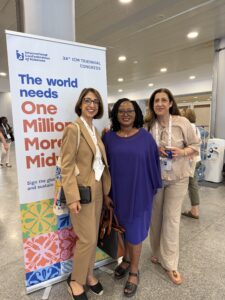 All the midwives at the MUNET workshop shouted together, alongside with Dr Casandra Yuill and Dr Lucia Rocca – Ihenancho, that birth is safer when it happens in midwifery led care units and the physiology is supported through the environment, the practitioners and the wider multidisciplinary (MDT) team.
The Shared Decision-Making workshop from the Dutch team, strongly suggested that personalised choice discussion is not a “midwife’s’ concern”. It is a structured tool available for the MDT team to adopt and to help them facilitate a safe and person-centred choice at birth and beyond. It is a tool to aid communication and designing of human centred care. It was a moment of reflection for all the participant, on “who we do serve or offer service to in maternity care”. Those powerful thoughts are travelling back home to many countries.
The call to “Keep the drums and lose the knife” on the Female Genital Mutilation workshop was a powerful message. Janet Fyle and her colleagues reminded us about the fact that while FGM has been illegal in the UK since 1985. However, it has only been since 2003 that it is illegal to take a British national or permanent resident overseas for FGM, or to help someone trying to do this. This also highlights the gap in international law about women’s rights and bodily autonomy. Midwives are more than carers here. As they are trying to educate generations, facing cultural resistance, to stop a practice that promotes a patriarchal school of thought and debilitates women causing significant complications and comorbidity concerning the reproductive health.
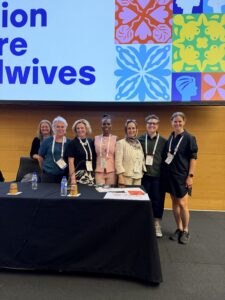 The discussion on the Continuity of Care (CoC)), facilitated by Hora Soltani, and with key speakers Alison Eddy, the new ICM President and Patience Gyampeh, the midwives from New Zealand and Canada, who questioned how midwives that are supposed to be, work and support women when they are working on systems where continuity is not supported, developed and structured to happen for all women. Despite the vast amount of overwhelming evidence to support that, the challenge here is not how to set up CoC but how to sustain the services in urban areas where midwives are overstretched and close to burn out. As the RCM pledges, Safe Staffing equals Safe Care and vice versa. If the numbers are fragmented, so is the care.
It is equally important to remember that reflective practice is the core activity for the learning of all individual midwives’, so it should be for the profession. Reflecting back and learning from others can strengthen the delivery of maternity care and support the delivery of the midwifery care models.
To conclude, it is paramount to state that the ICM Congress is a compass for midwifery. It will guide us next to Abu Dhabi for the 35th ICM, between the 4-7 of June 2029. Until this time, we all need to hold our promise and implement everything we learnt and shared in Lisbon, with colleagues, organisations, women and families, to shape stronger, safer and calm maternity care provision all across the world. Let the ripple effect carry the need to strengthen the midwifery profession to offer safe, satisfactory, evidence informed and personalised care.