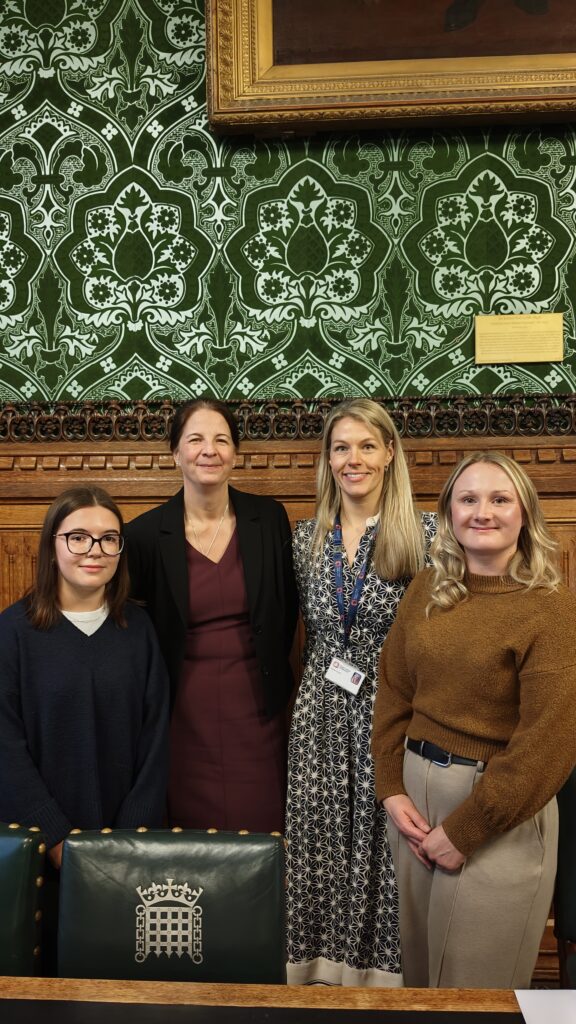
Lorna Forshaw, RCM Health and Safety Representative and frontline midwife (pictured far right), shares her experience of attending Parliament to speak about the urgent need for investment in maternity infrastructure.
I was really daunted at first when my organiser Rae asked me if I was interested in speaking at Parliament.
I’ve only ever been to London once, a long time ago, and I’ve never been close to Parliament, let alone inside it!
But as a frontline midwife and a RCM Health and Safety Rep, I know at first-hand the daily struggles we face trying to provide safe care in buildings that are crumbling around us, with equipment that fails us and staff facilities that simply aren’t fit for purpose.
If I had the chance to speak up about these issues in a room where change could actually happen, I had to take it.
I was invited to speak at the Maternity All-Party Parliamentary Group, which is a cross-party group of MPs and Members of the House of Lords, committed to raising awareness and pushing for improvements in maternity services.
The roundtable I attended was chaired by Michelle Welsh MP and alongside the RCM’s Deputy Chief Midwife Hannah Leonard and me, the meeting brought together many different voices.
This included the Care Quality Commission, Royal College of Obstetricians and Gynaecologists, Royal College of Nursing, British Association of Perinatal Medicine and the charity Bliss.
The experience was really empowering. It felt amazing to be in a room with people from different organisations, that share the same passions as me and my midwife colleagues.
I felt it was an open space to be able to share the concerns and frustrations that midwives, managers and heads of midwifery have regarding estates facilities.
The meeting covered so many critical issues. We heard about the widespread lack of adequate space across maternity units, with many not meeting basic Health Building Note standards. These are standards that haven’t been updated in over a decade.
We heard about the barriers that disabled women face throughout their maternity journey, from examination tables that don’t adjust properly to birthing spaces that aren’t wheelchair accessible.
We talked about the desperate need for proper bereavement facilities that allow families to grieve with dignity and privacy.
And running through everything was the impact on staff – the toll that working in these conditions takes on us as midwives and maternity staff. We are just trying to do our absolute best in impossible circumstances.
What struck me most was how universal these problems are. Crumbling buildings, broken equipment, inadequate space, no proper rest facilities for staff.
NHS England’s review last year found that over half of maternity and neonatal units are in unsatisfactory condition, with more than 14,500 infrastructure-related incidents disrupting care over just three years. These aren’t just statistics – they’re the everyday reality for midwives across the country.
Every woman giving birth deserves to do so in a clean, safe, dignified environment. Every baby born should come into a world where the facilities are fit for purpose. And every midwife and MSW should be able to work in conditions that allow us to provide the gold standard of care we all trained to deliver.
Michelle Welsh MP left me feeling humbled that she heard the points discussed in the room and they resonated with her. I left feeling confident that I had got my points across about how difficult it is for midwives across the UK to give the safe care they desire without adequate infrastructure.
It didn’t end in that room. The APPG will now put our case to the Government and Baroness Amos urging them to prioritise improvements in maternity and neonatal infrastructure.
I hope that by bringing members’ voices into that room at Westminster, we’ve moved one step closer to the investment and change our services desperately need.
Pictured from left: Student Midwife Hannah Kitchen, Director of Midwifery Emma Chambers, RCM’s Deputy Chief Midwife Hannah Leonard and Lorna Forshaw