MIDIRS Search Pack of the Month for August marks World Breastfeeding Week.
World Breastfeeding Week, which is celebrated this year from Saturday 1st to Friday 7th August, is an important opportunity to recognise the vital role that breastfeeding can play in improving health outcomes for babies and mothers. The week is described by the World Alliance for Breastfeeding Action (WABA) as “a global campaign to raise awareness and galvanise action on themes related to breastfeeding”. Since its beginning in 1992, the week has aimed to generate public awareness and support for breastfeeding.
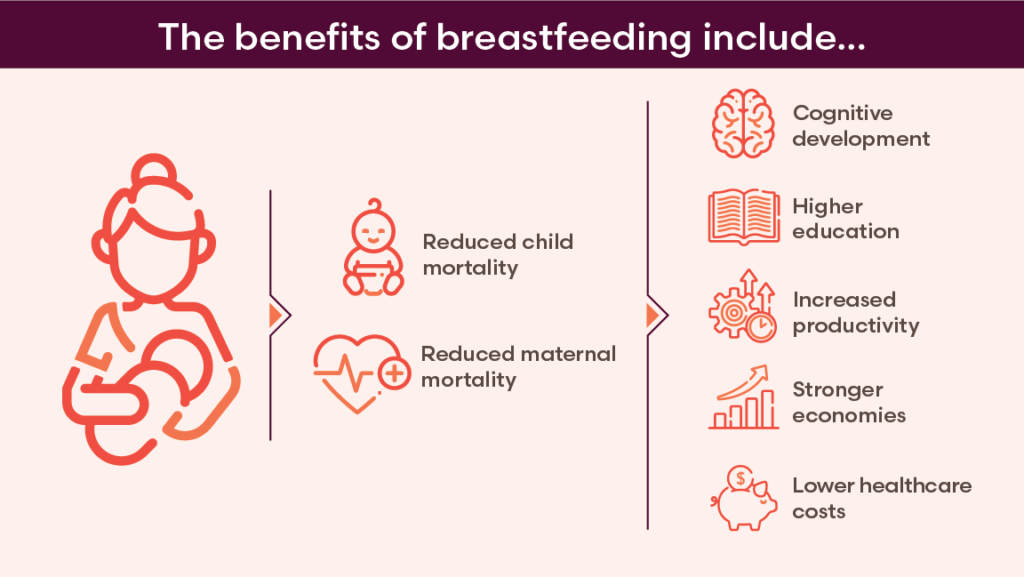
The theme for World Breastfeeding Week 2026 is “Breastfeeding for a Sustainable Start in Life: Strengthen What Works”, calling on governments, health systems, workplaces and society to build on successful experiences and strengthen support for breastfeeding. WABA writes that this year’s theme “will focus on tracking progress and evaluating breastfeeding impact on nutrition, food security and poverty reduction with highlights of successful implementation and lessons learnt”. The World Health Organisation have created several infographics on the benefits of breastfeeding, the economic cost of inaction and the impact of breastfeeding on mortality to demonstrate the sustainable aspect of breastfeeding, in addition to the known health benefits for mother and baby.
Maternity professionals are an important source of information and support for new parents during pregnancy and the early postnatal period. The attitudes, beliefs and knowledge of healthcare professionals can shape parents’ confidence, decisions and breastfeeding experiences.
To support maternity professionals in the provision of evidence-based care, and to mark World Breastfeeding Week, our Search Pack of the Month for August – PN63: Breastfeeding: Professional Attitudes, Beliefs and Knowledge – brings together evidence exploring how maternity professionals’ knowledge, perceptions and approaches to breastfeeding support can shape the experiences of women and families. Its resources support maternity professionals to reflect on practice, strengthen understanding and promote evidence-based, woman-centred care.
*NOTE: Access to this Search Pack for free has now ended. To view our latest Search Pack of the Month, please head to the Blogs, News and Views section of our website. To access the Pack, plus many more and our whole Maternity and Infant Care database, please consider subscribing to MIDIRS.*
What are MIDIRS Search Packs?
Our Search Packs are pre-made literature searches on topics within maternity research. They contain a comprehensive bibliographic list of articles as well as article abstracts. You can find a list of all of our Search Packs and information on accessing them here. If you require a more specific search, our librarians are also on hand to provide bespoke literature searches, which can be ordered on our Products and Services page.
Take a look back at articles on the topic of breastfeeding (professional attitudes, belief and knowledge) that have featured in past editions of MIDIRS Midwifery Digest:
‘A qualitative study exploring the factors impacting student midwives’ experience of developing their breastfeeding support skills’ M Tant, T Staras (December 2023)
Objective
To explore the factors impacting student midwives as they seek to develop their breastfeeding support skills while on a midwifery degree programme in the UK.
Methods
A qualitative online survey to gather responses from final year student midwives in the UK. Participants were recruited by the dissemination of the survey link via the Lead Midwife for Education email network. Data collected was analysed using thematic analysis to elicit key themes.
Results and Key Findings
64 responses were returned. Four key themes were identified: 1) expertise matters; 2) dissonance between the learning settings; 3) a challenging clinical environment; and 4) nothing can replace direct experience. Participants valued the theoretical underpinning from the university setting but needed greater input around how to deliver breastfeeding support practically and not feel underprepared for this area of practice. Students were positively influenced by time spent with infant feeding specialists. Students were impacted by staff shortages, resulting in their experiencing poor breastfeeding support practices and not getting adequate opportunities to practise their skills under supervision.
Conclusion
Students were keen to talk about their experiences in university and clinical areas. The degree to which they felt supported to develop their skills was variable and it is clear that more can be done to improve the student midwife experience in this area. Recommendations have been made, including more simulation in the university setting, more training for hospital staff to move away from old practices such as ‘hands-on’ and, finally, for more midwives to be recruited to ensure better conditions for student midwives and maternity staff, and for women and their families.
‘Enablers of and barriers to the increased provision of human breast milk for preterm infants’ M Rivett (June 2019)
It has been suggested that the perfect medicine for babies is human milk that only a mother can provide (Meier et al 2010), and Quigley et al (2018) assert that human milk can be lifesaving for preterm infants. Rivett (2019) previously discussed the cultural changes required to improve breastfeeding experiences for mothers of preterm infants so as to contribute to reducing infant mortality for this vulnerable group. This paper aims to explore how maternity and neonatal health services can support mothers of preterm infants who express a desire for their infant to receive human breast milk.
‘Midwives’ embodied knowledge of breastfeeding’ S Battersby (December 2002)
Midwives gain their knowledge of breastfeeding from a variety of sources. Part of this knowledge is empirical, gained through educational sources but many midwives will also have embodied knowledge gained through their personal experiences of breastfeeding. Both types of knowledge can influence how they respond and care for women but embodied knowledge is often perceived as subjective and inferior. The aim of this descriptive exploratory study was to explore midwives’ personal experiences of breastfeeding and the impact they may have on professional practice. Midwives at six maternity units were surveyed and there was a response rate of 57.7%. There were 307 midwives who had personal experience of breastfeeding. The findings demonstrated that midwives’ experiences of breastfeeding are not unlike those of the women for whom they care. Many commence breastfeeding, find it problematic and discontinue it for the same reasons as non-midwife mothers.
To read these papers in full, plus thousands more midwifery-related articles, subscribe to MIDIRS and access our full MIC database, as well as our quarterly Digest.