About the Author
 Holly Manton is a midwife working at University College London Hospital. She has been qualified since 2017 and has worked across all areas of midwifery. Most recently, she has been working in a continuity team and has a caseload in Camden, the same area in which she lives.
From the NHS to the Mediterranean Sea: my experience as a search and rescue midwife
Following the covid pandemic and a busy six years as a qualified midwife working at University College London Hospital (UCLH), I decided to take a career break. I sublet my room to a friend, packed up my possessions and spent some time hiking in New Zealand, Japan and the UK. On some of these walks I started wondering what else I could do with my break from the NHS. Having worked in a caseloading team following the continuity of carer model, I’d gotten to know several families that were experiencing the UK Home Office’s many flaws and who were living challenging lives having fled conflict in their home countries. With this in mind, I came across a job posting for a midwife role with SOS Humanity, an NGO, working in the search and rescue (SAR) field in the Mediterranean Sea. This felt like an opportunity to work more closely with people on the move and hopefully shine a light on the realities of the journeys so many of the families in our care have made.
Onboard a ship named Humanity 1, for SOS Humanity’s fifth rotation in May and June 2023, we performed two rescues with a total of 118 survivors including one four-month-old baby and two pregnant women. SOS Humanity’s mission is to rescue people in distress at sea in the Central Mediterranean, protect and assist, treating everyone with dignity. The aim is to document the stories of people on the move and highlight human rights violations and ultimately promote change by bringing awareness to the consequences of European migration policies.
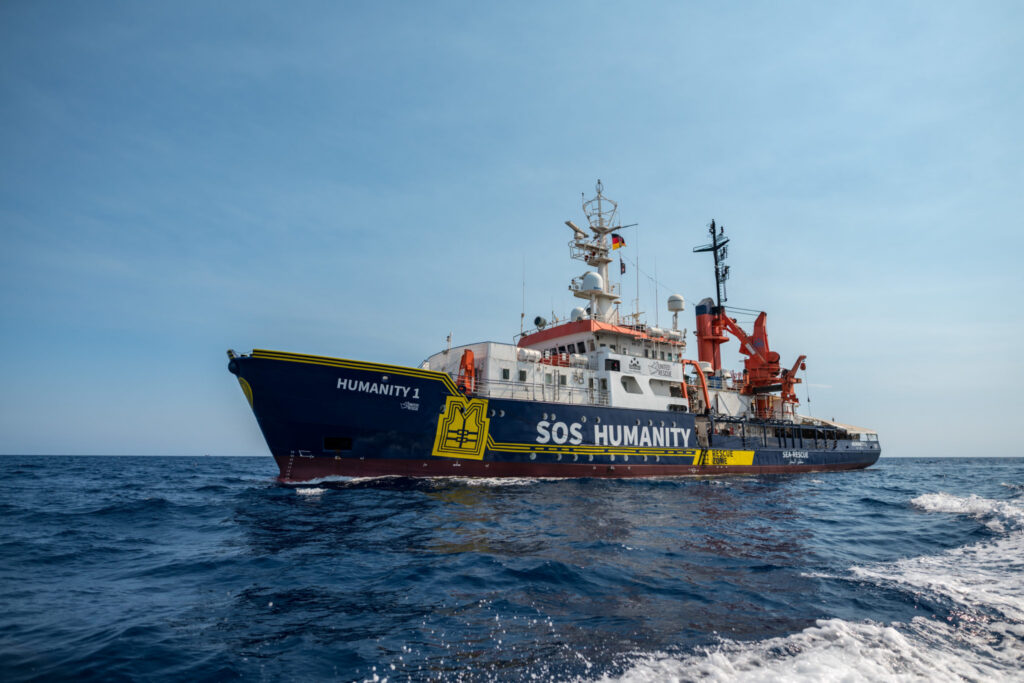
I read the accounts of previous volunteers and crew, and testimonies of survivors, but it was very hard to imagine what life at sea for a month would entail. I was excited and apprehensive to arrive at the port of Syracuse, Sicily. I met Lotte, the RHIB (Rigid-Hulled Inflatable Boat) driver, en route and I quizzed her as we approached the 60m ship. It was reassuring to hear she was very experienced in the SAR field.
We had a very busy week of training prior to departing into the SAR area to be “ready for rescue”. I learned so much about marine safety, emergency procedures, standard operating procedures and was quickly informed of the difference between a boat and a ship by the Captain, Josh, who said “You can put a boat on a ship, but you can’t put a ship on a boat”. We performed multiple training drills, both as the medical team and with the whole crew.
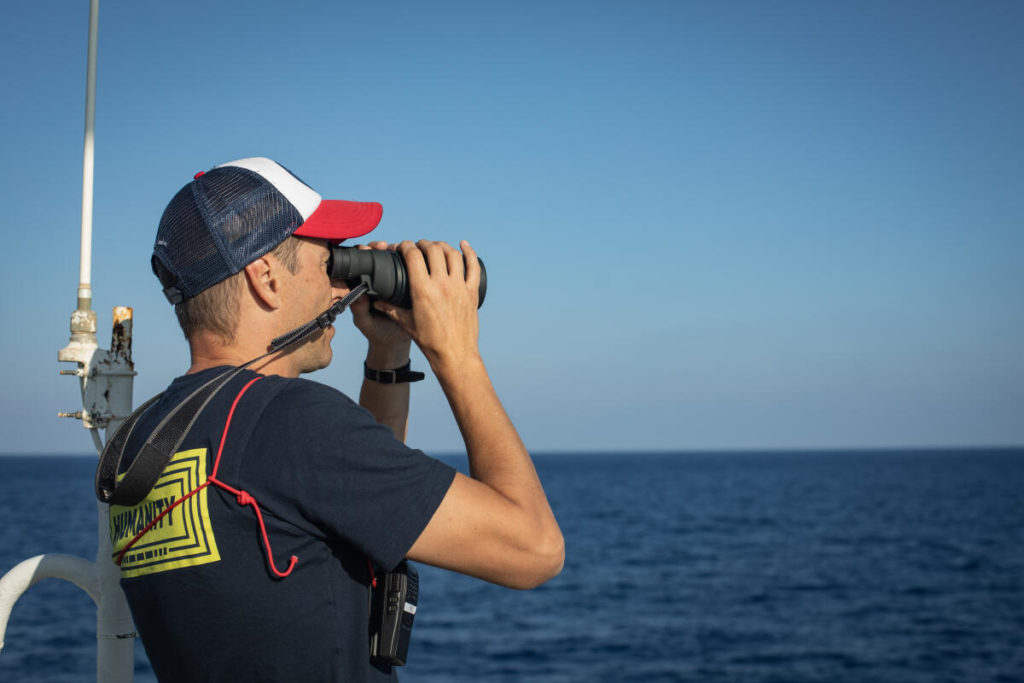
Both rescues we performed were at daybreak. The small, unseaworthy vessels were just dots on the horizon against the vast seas and the rising sun. This felt particularly poignant. On both occasions we had been informed of the boats in distress and travelled at full speed all night to find them. I will never forget the moment a father passed up his four-month-old baby onto the ship, naked, wrapped only in a damp coat, the driest thing they had left. The parents had done the best they could: despite spending days and nights at sea in a small, overcrowded, inflatable boat with waves splashing over the sides, they had managed to keep their baby from developing hypothermia. I quickly escorted the mother and baby into the medical room and washed the salty water off their skin, dried and wrapped the baby in thick blankets for the mother to hold. The baby warmed up to a normal temperature within two hours, but any longer at sea and it could have been a very different story.
The women I provided care for had not had access to medical care for a long time: the mother had not had a medical professional present at her birth in Libya, and the pregnant women had not had access to pregnancy tests or antenatal care. I was able to offer this to them to confirm their pregnancies and provide a pregnancy assessment. During this assessment the expectant mothers heard their babies heart rate for the first time, and I was pleased to see that all my observations and assessments were within normal parameters. It was also an opportunity for the pregnant women to ask questions and gain some antenatal education, with the help of our onboard translator.
Without access to antenatal care, pregnant women are at risk of complications going unnoticed, putting both their life and the baby’s life at risk. Time can be of the essence in maternity emergencies or imminent deliveries: knowing that these women were safe whilst onboard with us and that they would have continued care in Italy was very reassuring. We observed from a distance that onboard another rescue ship in the SAR area was a pregnant woman in labour who had been rescued from a small unseaworthy vessel. I was asked to be on standby for advice and guidance because the vessel did not have a midwife or obstetrician onboard. Fortunately, they were able to medivac her safely to Italy prior to delivery.
Once the survivors are onboard Humanity 1, they are in a protected environment where we can restore some hope in humanity and care for them before they continue their journeys in Italy and beyond. One of my favourite metaphors is considering our wellbeing as how full our cup is; we can’t pour from an empty cup. For many displaced people, especially women and mothers travelling with uncertainty and fear for long periods, it is necessary to enable them to rest whilst onboard. This is why the women and children’s shelter is so important. It is a private space of safety and security where they can start to refill their cups. Alongside this we offered all survivors opportunities to have haircuts and manicures, do painting, friendship bracelet making and exercise, dance to music and play board games, with the aim of providing a welcome distraction from the difficult realities the survivors are facing. I hope that their cups were topped up whilst they were onboard in preparation for their continued journeys and the Italian asylum-seeking process.
My time onboard Humanity 1 opened my eyes to the tragedies happening to so many people fleeing war, conflict, and human rights violations. I met so many amazing survivors that, despite being amid such challenging journeys, showed each other and the crew so much love, kindness, humour, and resilience. People from different countries and cultures lived harmoniously next to each other onboard the ship during the voyages to Italy. We danced, talked, listened, and comforted.
A couple of years have passed since my time onboard Humanity 1. I am back working as a midwife at UCLH in London. I still meet families who I suspect have made similar journeys to those weary souls we assisted aboard Humanity 1. My time at sea opened my eyes to the tragedies of displacement, but also to the immense resilience and kindness of the survivors. I know the care we provide can make a profound difference in people’s lives. It remains an immense privilege to welcome everyone- no matter their journey- into our brilliant NHS.