 About the Author
Meg Hyslop-Peart is a Fetal Monitoring Lead Midwife at Manchester University NHS Foundation Trust and is undertaking a Master of Clinical Research at the University of Manchester, supported by an NIHR Pre-Doctoral Fellowship. Her research focuses on improving safety and communication in intrapartum fetal monitoring through co-designed research with women and maternity professionals.
'Fresh Eyes' in maternity care: how well do we understand this safety intervention?
A practice widely used but poorly understood
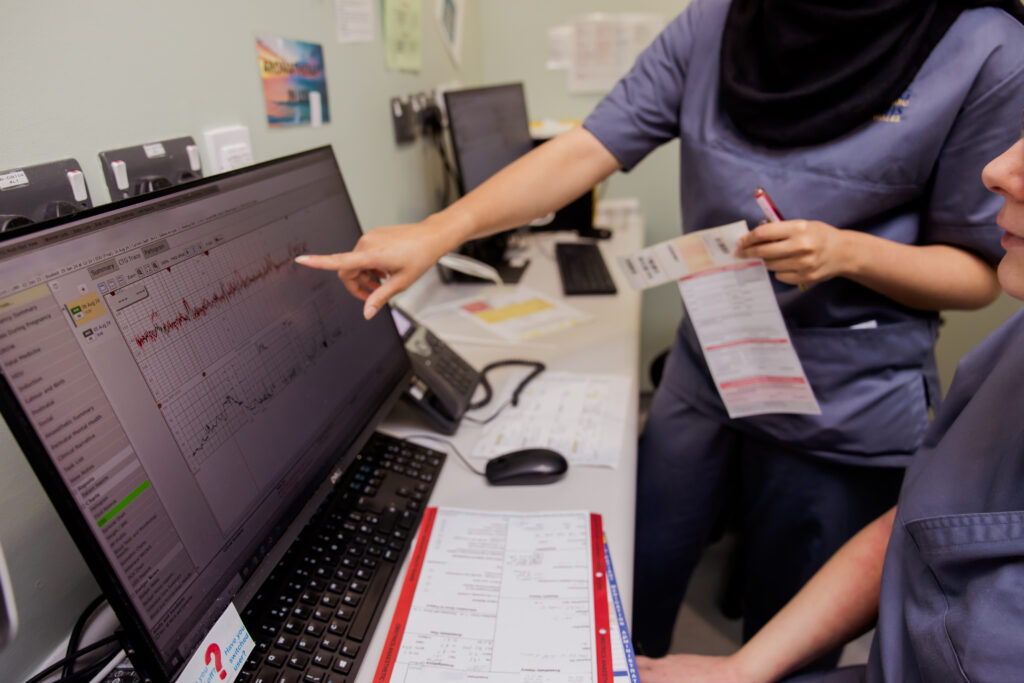
Across UK maternity services, clinicians are familiar with the concept of “Fresh Eyes” or “Fresh Ears” as a structured second review of fetal monitoring, typically cardiotocography (CTG) or intermittent auscultation findings. These are undertaken by another clinician to provide an “objective” and “holistic” assessment.
“Fresh Eyes” reviews are recommended to be completed hourly during continuous monitoring, and 4-hourly for intermittent auscultation; however, there is no detail as to when in relation to a previous review it should occur.
- Is it anytime within the hour, or is it immediately, or is it within 15 minutes?
- How do we ensure it is objective?
- What is meant by objective?
- Who is allowed to complete a “Fresh Eyes” review?
- What happens when clinicians do not agree?
- Where should “Fresh Eyes” take place, i.e. at the bedside?
- What is meant by holistic?
Due to a lack of national guidance on these questions, and research around this topic, individual trusts have come up with their own guidelines around this, however this creates inequity and inconsistency.
Importantly, we also know very little about how “Fresh Eyes” is experienced by the people at the centre of care; women and birthing people.
- Does it feel reassuring to them?
- Is it explained clearly?
- Do women know it is happening?
- Does it enhance communication, or does it sometimes feel intrusive?
These questions are rarely captured within traditional maternity safety research.
Listening to different perspectives
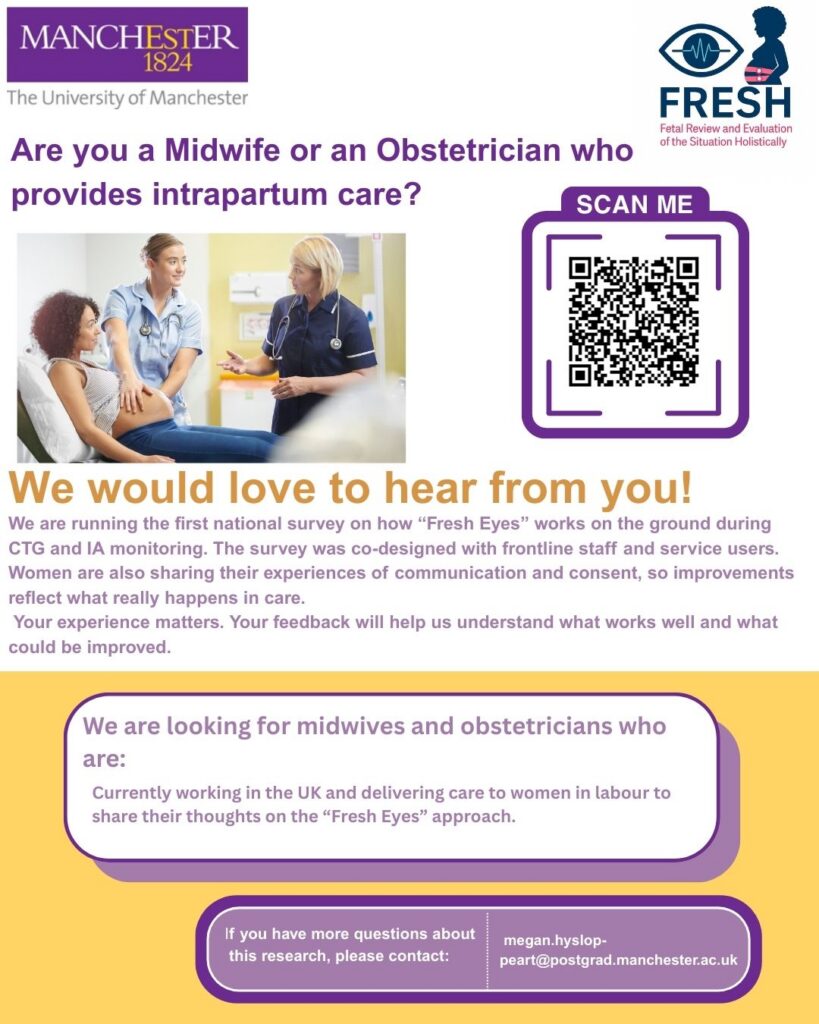
To address this gap, I am conducting a national UK survey exploring how “Fresh Eyes” is implemented and experienced across maternity services.
The survey has been co-designed with women with lived experience, midwives, and obstetricians to ensure the questions reflect what matters in practice, not only what is traditionally measured.
The study includes three groups:
- Fetal monitoring leads responsible for implementation
- Frontline maternity staff who use Fresh Eyes in daily practice
- Women and birthing people who experienced fetal monitoring during labour
Why this research matters now
Maternity services are under increasing pressure to demonstrate safety improvements while also improving personalised care and communication. National reports have repeatedly highlighted failures in escalation, teamwork, and listening to women. “Fresh Eyes” aims to address some of these challenges, but without evaluation we risk assuming effectiveness without understanding mechanisms or unintended consequences.
Research that includes both clinician and service-user perspectives can help us understand:
- How “Fresh Eyes” is actually being used
- What helps or hinders implementation
- Whether it supports psychological safety for staff and women
- How practice varies across the UK
Ultimately, this work aims to support evidence-informed conversations rather than prescribe a single model of care. This research has proportionate ethical approval by University of Manchester. The protocol for this research can be found below.
Understanding “Fresh Eyes” is not only about fetal monitoring. It is about how maternity teams make decisions together, how uncertainty is managed in labour, and how women experience safety interventions intended to support them.
Maternity professionals can participate in the survey at the link below.