

 About the Author
Gillian Meldrum was an NHS midwife for almost 40 years as a caseloading team midwife, then as practice development and infant feeding lead. She is now retired and an engaged member of the Association of Radical Midwives working to campaign for improvements on maternity experiences.
Adapted from a review originally published in Midwifery Matters, Issue 187 (December 2025).
Have you ever been concerned about how to respond, as a midwife or birthworker, when you are expected to do or witness something during maternity care that you feel is ‘not quite right’?
If so, this is a great book for you, which will help you understand the pressures to conform to the expectations of your workplace culture, and how you can begin to learn to respond in a way that expresses your true self and perhaps reduces the trauma and harms that some mothers and families sadly experience.
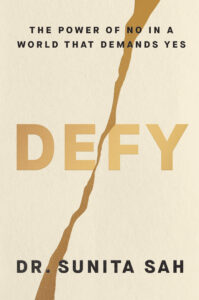 Dr Sah’s definition of “defy” is “to act in accordance with your true values, when there is pressure to do otherwise” – and her book is a fascinating reflection on different examples of defiance, and compliance, drawn from her personal life, well-known events, and psychological research into human decision-making.
Shah describes herself as a ‘good’ child growing up, in a family of Indian heritage in Yorkshire which gave her a ‘masterclass in obedience’. She trained as a doctor in the UK before moving to USA where she is now Professor of Management Psychology.
The topics addressed cover corruption and police violence, sexual harassment & abuse, bullying, whistleblowing, racism, activism, maternal protective instincts, safety culture, consent in healthcare and much more.
She explores how difficult it can be to speak up when you witness (or collude with) something you know is not OK – because we are all socially conditioned to connect with and others and fit in with their expectations, because there may be potential harmful consequences to speaking up, and because we often feel it will make no difference.
She describes the 5 stages of defiance:
- An uncomfortable, visceral feeling of tension which can feel like fear
- Acknowledgement (to ourselves) of the cause of the tension and what doesn’t feel right – simply reaching this stage can be beneficial in itself
- Escalation (vocalisation to others) – this might be very tentative, like “Are you sure this is OK?” or more challenging, like “What do you mean by that?”
- Threat of non-compliance – where you clearly voice your defiant view, but comply with the expected behaviour nevertheless
- Act of defiance.
People don’t always follow all the stages in that order, and in many cases stage 5 happens after a slow-burn process, following reflections on how you might have responded better, rehearsing a script, considering the risks to yourself and others, before finally deciding to defy and act according to your true values. She emphasises that we can all practice and learn to become more defiant, and at the same time she discourages us from viewing it as personal weakness if we fail act as we might have wished.
She reflects on Milgram’s experiments on obedience in the 1960s where subjects were told to give painful and potentially lethal electric shocks, to actors pretending to experience the shocks. The vast majority of participants did as they were told and administered the shocks, because they were told they had to – and Sah analyses the data about what helped some people to defy the orders. One was the presence of another person who also attempted to defy – unsurprisingly, like-minded people can give you so much more confidence. Technical knowledge and understanding of the potential harms helped an electrician refuse to comply with instructions.
The section on consent, what she calls ‘defiance’s twin’ is really useful for midwives and other healthcare workers. She describes the 5 elements of consent, all of which are essential for consent to be valid – capacity, knowledge, understanding, freedom (to say No), authorisation (an explicit, affirmative Yes).
I’d love to summarise all the amazing stories she tells – but I’m going to simply urge you to read the book. It is very easy to read, but if you are not a keen reader, there are lots of videos for her book promotions on YouTube – I watched a couple and was inspired to buy the book and find out much more.
I hope you enjoy it and draw some strength from it to help you act in accordance with your true values, in all aspects of your lives … and see what ripple effects might occur.